A Free Playtest Expansion · Sits Alongside the Playtest Pack
Free expansion v0.1 · Share freely · do not resell
PLAYTEST · BATTLE GROUPS · v0.1
When the Fight Is an Army
The same 2d6 + Trait engine, scaled up: a Battle Group rolls exactly like a character, but one roll now represents several hundred men, a galley's crew, or a column on the march.
Read it through once. ~24 pages. Plays solo or with a GM. New here? Start with the Playtest Pack →
WHAT YOU NEED AT THE TABLE
Two dice, a pencil, and the core engine
- ·Two six-sided dice per player. The same 2d6 + Trait you already know.
- ·The Playtest Pack rules sheet, or the core rulebook — any 2d6 + stat system will hold the shape.
- ·A printed Battle Group card (§9 of the PDF). Photocopy, fill in pencil, cross out as the battle progresses.
- ·A name for each side and a target the GM holds privately. The dice are open; the target is not.
PART I
What a Battle Group Is
A character, scaled up
A Battle Group has a single Trait (its drilled competence), an Order track (Steady → Wavering → Broken), a cost in points, and whichever theatre rule applies. That is the whole sheet.
Wavering rolls 2d6 with no Trait bonus. Broken has left the field. Everything else is the core engine.
The single rule that does the work
Flanking or rear attack: the defending Battle Group rolls with no Trait bonus.
This one sentence is why Manzikert, a feigned retreat, and a gallery breakthrough all resolve with the same engine.
The battle round
Side-based initiative, as Chapter 5. One action or one move per Battle Group. Hold actions for triggers — that is how feigned retreats, ambushes, and counter-mines are built at the table.
Not every armed encounter needs the dice. A routed raiding party, a watchtower against a relief column — the GM may simply narrate the result. Battle Groups is for engagements where the outcome is genuinely uncertain.
The dial — how big is this fight?
- Skirmish — a band of 10–20 fighters · 15 points
- Engagement — a company of 100–300 · 30 points
- Field battle — a regiment of 500–1,500 · 45 points
- Campaign hinge — a tagma, a whole wing · 60 points
PART II
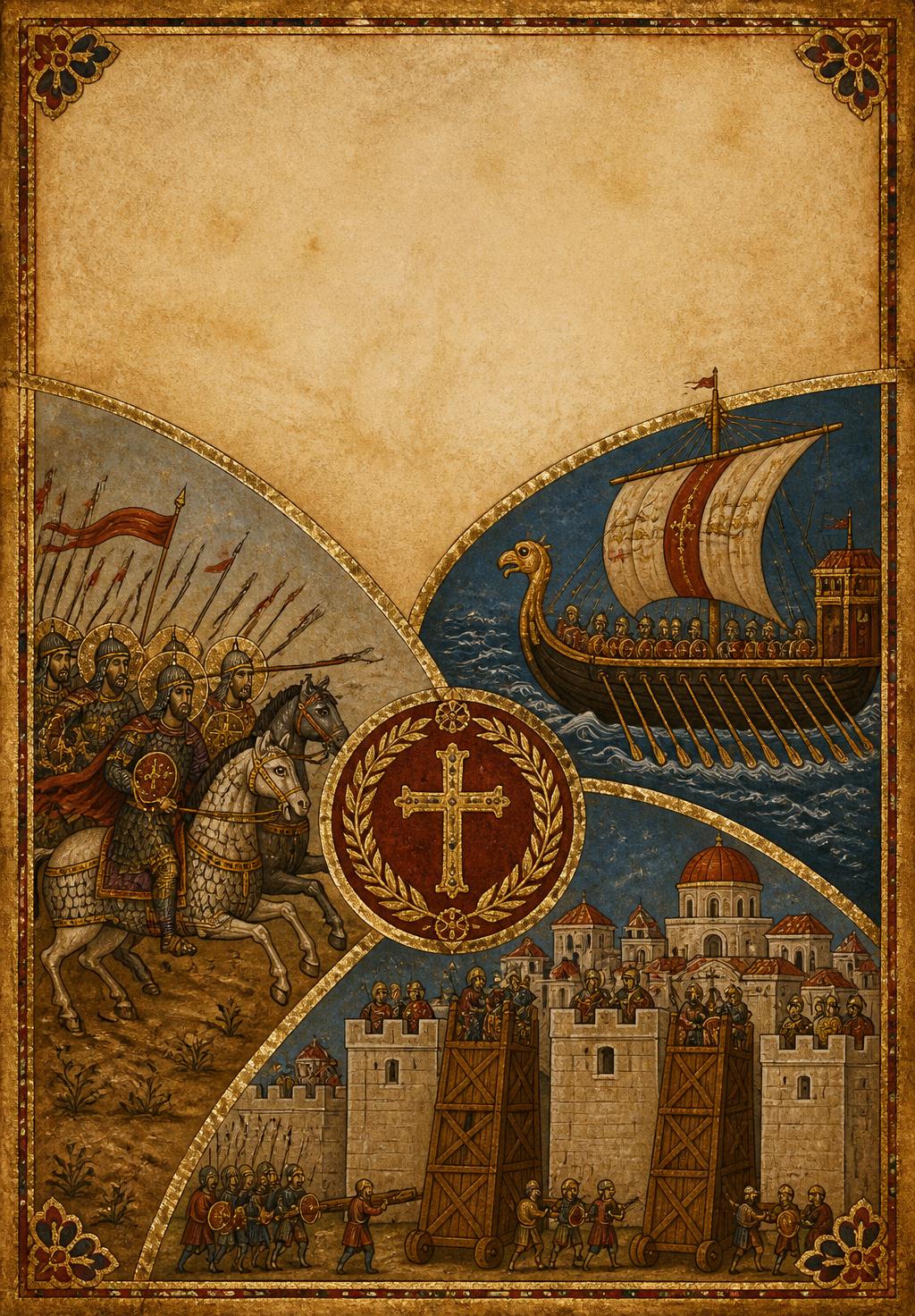
Six Theatres, One Engine
Each theatre either modifies the default exchange or replaces it with a small theatre-specific roll — never both at once. The theatres are written to be used independently; if you only ever need §5.5 for one dramatic session, you do not need to read the rest.
§5.1
Open Field
The default exchange. Terrain and position modify the roll exactly as cover does for a person — high ground, defended crossing, attacking uphill.
§5.2 · CAPPADOCIA
Mounted Operations
Horse track (Winded / Lamed / Foundered), forced-march check, the couched charge, the bow from the saddle, and the Mystic's blessing on the horses.
§5.3
Mountains & Passes
The defile ambush — setting roll on 7 / 9 / 11 ground, break roll for the ambushed commander, terrain belongs to whoever knows it.
§5.4 · AMORIUM
Sieges
The siege dashboard governs the slow weeks. Battle Groups resolve the sharp moments — sortie, breach, relief column — with siege-specific modifiers.
§5.5 · NEW
Underground — the Gallery Fight
Only one named fighter engaged at a time. Listening roll, the press, firing the props (the one single-roll Battle Group removal in the module), smoke and the siphon.
§5.6 · CONSTANTINOPLE
Naval — Galley Combat
Ship track (Strained / Holed / Foundering), sea state as named adversary, position before exchange, then ram / board / burn / break off. Saltwater Grace included.
PART III · SOLO SCENARIO
Manzikert, 26 August 1071
A WORKED ENGAGEMENT · SOLO OR TWO-PLAYER · ~50 POINTS A SIDE
Byzantine 51 — Tagmata ×2, Thematic ×2, Kataphraktoi ×2, Norman mercenaries, and a Varangian Reserve. Seljuk 55 (deliberately heavier) — Ghulam heavies, four Turkmen horse-archer groups with two upgraded for Feigned Retreat, Light Raiders, and Alp Arslan attached to a Ghulam group.
Solo play in three lines
The PDF gives a three-line priority list the Seljuk side checks in order each round, and the historical Doukas / Reserve mechanic — a private target the Emperor rolls against to commit the Varangians. The dice are open; the target is not.
Two ways to play it
FOR A FAIR FIGHT. Have the Emperor commit the Reserve cleanly and split the line. The dice will decide whether Byzantine drill carries the day.
FOR THE TRUE FEEL. Play Doukas honestly against the private target. Then you will understand why a Byzantine win at Manzikert would have been the remarkable outcome it would have to be.
PART IV
The Printable Battle Group Card
§9 of the PDF is a single page with two Battle Group cards — photocopy, fill in pencil, cross out as the battle progresses. One per Battle Group. Name, Type, Trait, Cost, Theatre, Order track, Secondary track (horse, ship, —), Special Rule, and the attached Commander.
PLAYTEST · BATTLE GROUPS · v0.1
Run it. Tell us what broke.
Battle Groups feeds the same playtest loop as the rest of the pack. Take it to a table, push it until something fails, then come back and tell us what sang, what broke, and whether you'd play it again.
Every playtester whose feedback shapes a change is named in the back of the printed book.
Hall of friends · Back to the Playtest Pack
Free expansion v0.1 · Share freely · do not resell · pairs with the core rules, but every subsystem lifts cleanly into any 2d6 + stat game.