The Soldier
Tagmata, thematic, or Arab ghazi — someone the army trained and then mostly forgot.
PRIMARY · BODY
EDITION II
A grounded historical RPG of the Byzantine–Arab frontier. Small parties. Hard miles. No clean victories.
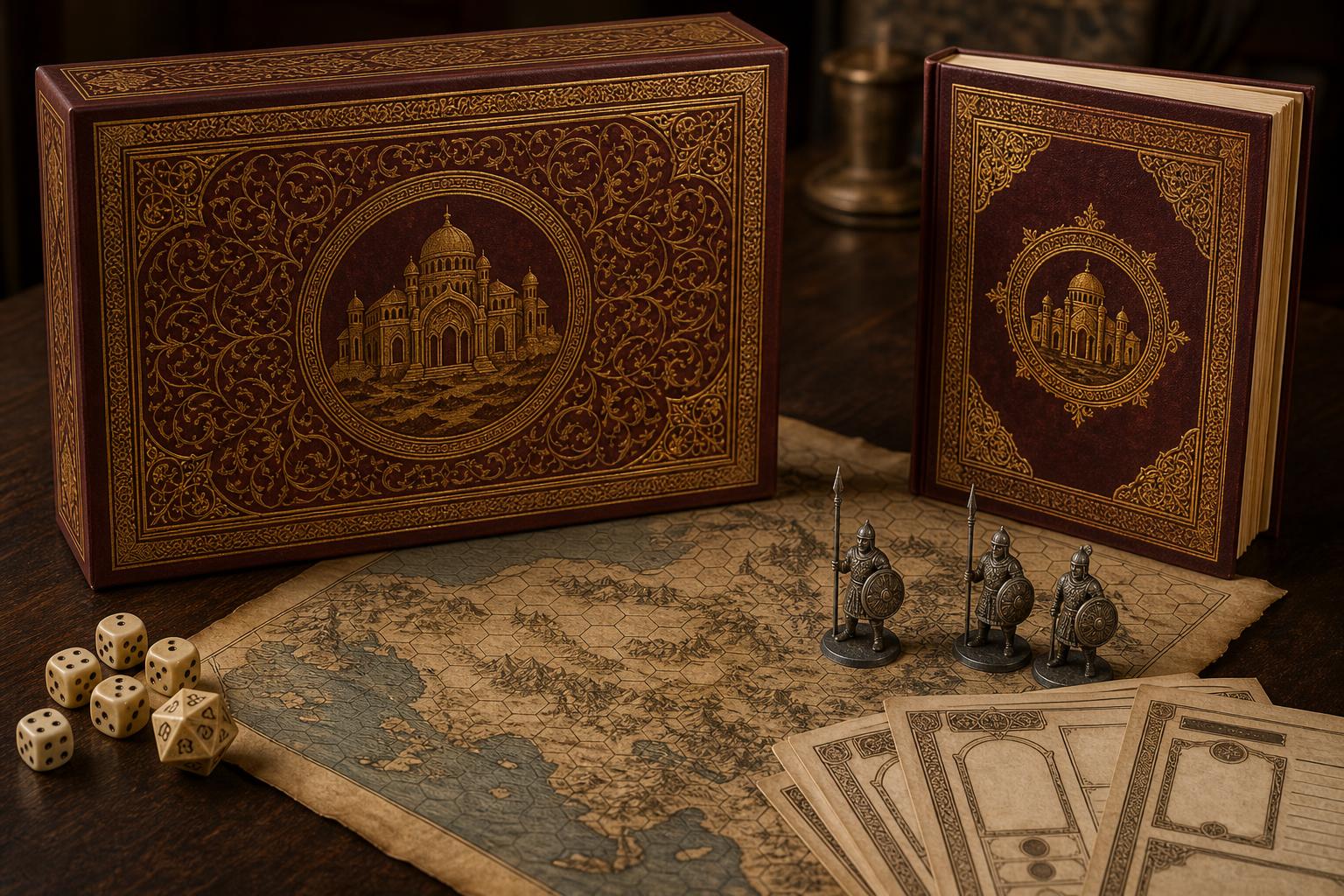
THE PITCH
Children of New Rome is a tabletop RPG of the 9th-century Mediterranean frontier. You are not heroes — you are people the world has used hard, thrown together by debt, faith, exile, or a job nobody else would take. The Byzantine and Abbasid empires bleed along a thin road through the Taurus mountains, and you walk it. Towns are small, miles are long, and the dead are usually just dead.
The rules are elegant by design: a single core mechanic, light bookkeeping, deep choices. The period does the heavy lifting — and the GM has tools, not tricks, to help a session find its shape when the players (as they always do) refuse the door you opened for them.
DESIGN
One core resolution. One damage system. No subsystems that exist only to prove they could.
Real 9th-century texture — coinage, languages, faiths, food, law — does more work than any invented mythology.
Mystics, priests and imams have power because their world believes they do. The GM sets the dial on what is true.
Most scenes are decided by talk, money, or movement. When swords come out, someone usually dies — including PCs.
Soldiers, churchmen, merchants, judges. There is no clean side. The players choose which dirt they can live with.
THE RULES
When the outcome is in doubt, roll 2d6 + a Trait against a target the GM names aloud before you roll. Most things sit between 7 (everyday) and 11 (a feat).
No skill list. Four Traits — Body, Wits, Heart, Faith — and a single Background word ("tagmata soldier", "village midwife") that grants advantage when it plausibly should.
No hit points. Every character has three slots: Shaken, Bleeding, Down. A hit fills the next empty slot. Down means dying unless someone reaches you before the next scene ends.
Armour does not absorb — it changes where the hit lands. Mail turns a killing thrust into a broken rib. A peasant in linen takes the same blow through the gut.
A whole fight resolves in three or four rolls. A duel can end in one. Players learn quickly that combat is the worst answer to most questions.
THE PEOPLE
Origin is flavour, not mechanics — the frontier holds Romans, Arabs, Armenians, and everything the passes have mixed.
Tagmata, thematic, or Arab ghazi — someone the army trained and then mostly forgot.
PRIMARY · BODY
Frontier warden of the Taurus passes — half-Roman, half-Arab, bilingual, owing the empire nothing it cannot collect.
PRIMARY · BODY
Priest, monk, imam, or village wise-woman. Burns Grace on rites: blessing the dying, turning the unquiet dead, reading dreams.
PRIMARY · FAITH
Bodyguard, factor, translator. Knows three languages and which official takes which bribe.
PRIMARY · WITS
Bone-setter, midwife, herbalist. The party's last argument against dying.
PRIMARY · HEART
Greek-trained or Baghdad-trained. Reads what others can't. Asks questions that get people killed.
PRIMARY · WITS
A name on a writ in some other province. Useful, untrusted, and one bad night from the rope.
PRIMARY · BODY
ADVANCEMENT
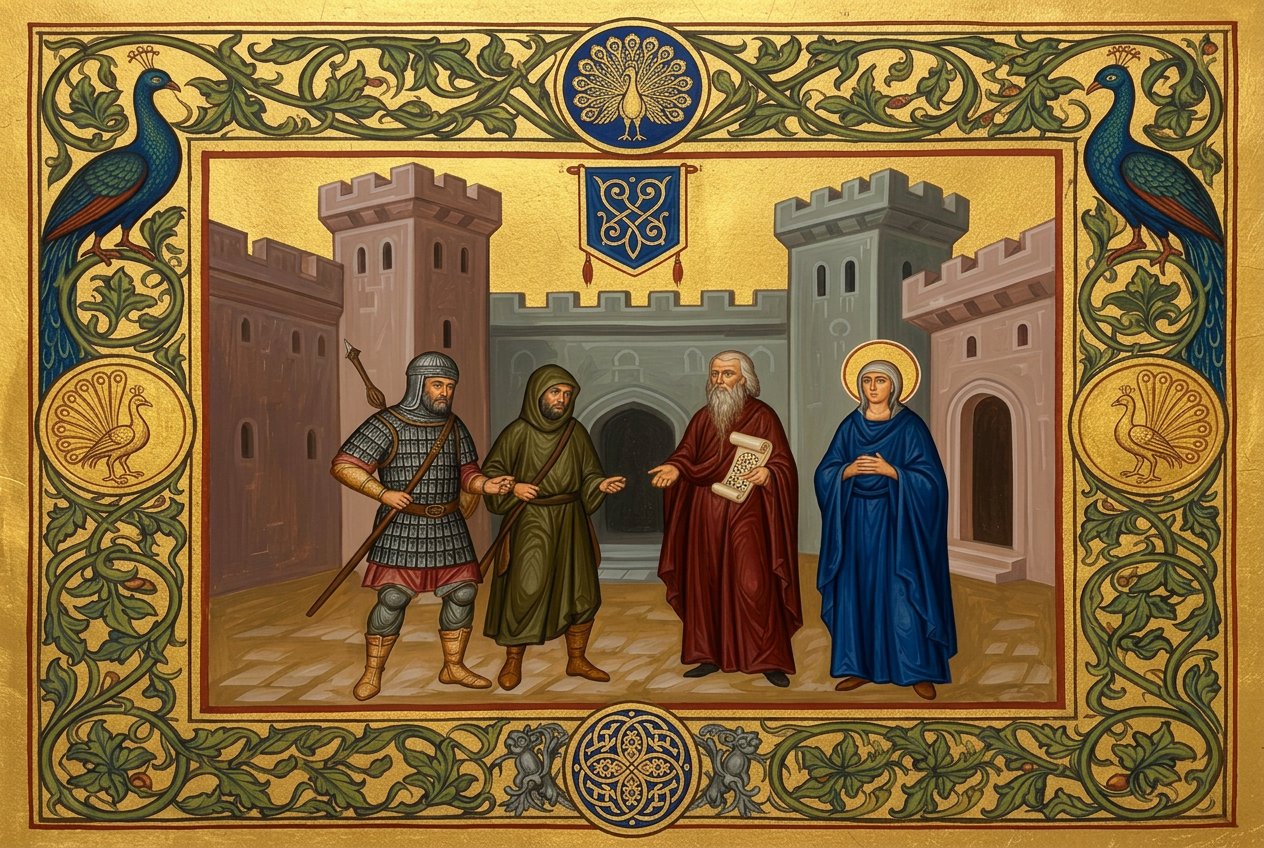
There are no levels and no experience points. Characters advance the way Romans did: by deeds witnessed and remembered. Every session the GM awards Kleos — the bright name — and ticks the appropriate Renown axis: Piety, Cunning, Largesse, or Valour. When you cross a threshold you do not "level up". You write a short petition, in your character's voice, asking the world to recognise what you have become. The GM grants it, denies it, or counter-offers a humbler rung.
| TIER | KLEOS | AXIS | WHAT IT LOOKS LIKE |
|---|---|---|---|
| Spoken for | 10 | — | The village knows your name. You can vouch for another at the kontoubernion or guild. |
| A trade of your own | 20 | any 3+ | Master of a small workshop · decarch over ten spears · cellarer of the monastery · the midwife the women send for. |
| A name in the district | 40 | any 5+ | Headman of the village · pentekontarch over fifty · senior notary to the bishop · an akritas trusted with twenty riders. |
| Reckoned in the theme | 75 | any 7+ | Kentarchos over a hundred · archon of a small kastron · master of a guild house · the akritic captain the strategos sends for by name. |
At Reckoned in the theme a character may petition for an advanced class — Tourmarch of the Pass for an Akritas, Protonotarios for a Scholar, Hegoumenos for a Mystic. Each is a senior role within the theme, reached via a named junior rung.
At the same threshold (75 Kleos, axis ≥ 7) a character may instead petition to bear a second archetype — a stratiotes who has also become a notary, a healer who has also taken minor orders, an outlaw the village has slowly permitted to become its smith. The fiction must support it. The sheet gains the second archetype's Edge menu and nothing else; the Traits are the Traits.
An optional parallel track. Infamy is read on the same four axes and runs from a name in the dark to the brigand chief the district fears. The book carries it as a sidebar — use it if your table wants it.
A NOTE ON CEILINGS
These are the lives of free Romans of the themes — Joe Bloggs of 838. They will not become Masters of a Theme, cupbearers to the Basileus, or despots of cities. Advancement is small and pivotal: the village headman, the kentarchos, the master of a workshop. If a character outgrows the theme, the road continues — in Children of New Rome, our online multiplayer RPG of prose orders and prose results — where the same Kleos, the same four axes, and the same petition system carry the character into the world of strategoi, logothetes, and the City itself.
THE GM'S BOOK
Players never take the road you laid out. They burn the inn, marry the villain, or follow a stranger they were supposed to ignore. The GM book is built around that.
Every scenario ships with three plausible ways forward: the soldier's, the priest's, the merchant's. If the party invents a fourth, the same NPCs and stakes still fit — just rotated. No prepped path goes to waste.
Six factions, each with a six-segment clock that ticks toward a named event (a raid, a tax census, a martyr's feast). The world moves whether the party does or not. Improvisation has gravity, not chaos.
Every named NPC has five lines only: name, one detail, what they want, what they will lie about, and what they would risk dying for. That is enough to play them anywhere the party drags them.
When a scene drifts, the GM may name a Pull — a small piece of period truth (a semantron sounds for prayer, tax collectors enter the square, a known face appears) that re-engages stakes without railroading.
One page, set at session zero. From 'It's all in their heads' to 'The dead walk and saints answer'. Mystic powers, undead, omens, and miracles all scale to where you set the dial.
Frontier settlements pre-built on two facing pages: who runs it, who hates whom, what's buried under the church. Drop one in any session in five minutes.
STARTER ADVENTURE
A ONE-NIGHT FRONTIER MODULE · 3–5 PLAYERS
Best with 3–5 players (the core game supports 2–5).
A reliquary — a finger-bone of Saint Theodore — has been stolen from the monastery above the frontier town of Loulon. The abbot can pay. The thematic judge wants it back before the strategos finds out. The merchant who bought it has already promised it to a buyer in Baghdad. Three roads lead out of this. None of them are the one the party will take.
By the end of the night the party will have been lied to by everyone, possibly killed a soldier they could have talked down, walked away with ten nomismata, and made an enemy of one faction they didn't even know they had crossed. The GM will have learned the tone: nobody tells the truth, every faction is compromised, and the right thing costs more than you have.
AT THE TABLE
In 838 the Mediterranean was the most multi-religious place on earth. Christians, Muslims, and Jews lived, worked, fought, traded, married, and prayed alongside each other. The game treats every faith as it would be treated by its own faithful: sincerely, intelligently, and without caricature. Villains are people, not religions. The book says this plainly on its first page, so every table starts in the same place.
THE GENERATOR
Every copy of the book — PDF or boxed set — comes with a code printed inside. Redeem it on this site and the online character generator unlocks the parts the book pays for:
The basic generator stays free for everyone, so anyone can try a character before they buy.
PLAYTEST PACK · v0.1
Quickstart rules, four pre-generated characters, and The Abbot's Debt in full.
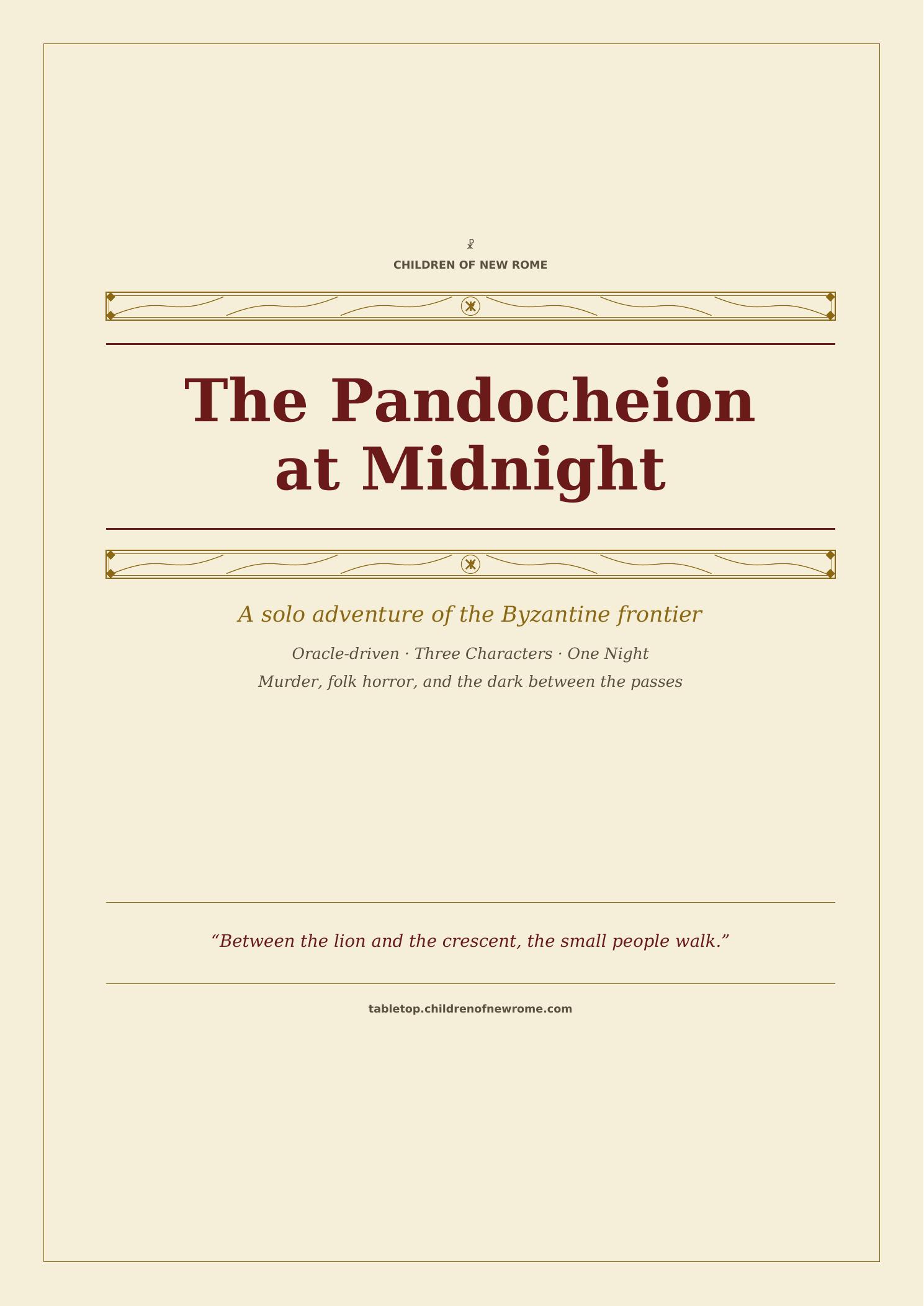
TRY IT FIRST · FREE ONE-HOUR SCENARIO
A pandocheion. A blizzard. A body nobody admits to knowing.
A self-contained taste of the system before you commit to the rulebook — one evening, three characters, no prep. Solo or with a single friend.
GET THE FREE PDF →FREE · 32 PAGES
A playable taste of Children of New Rome: the core rules, four pre-rolled characters, and a one-evening scenario on the Cilician frontier. PDF, A4 and US-Letter spreads.
We use your email only to send the quickstart and the occasional field-notes piece. Unsubscribe with one click. No third-party sharing.